

THE HAKKA ODYSSEY
Identity, Culture, and Beyond | 客家
Tracing the resilient journey of the "Guest People" from ancient Central China through five historical migrations to global communities across the Caribbean, Asia, the Americas, and Canada.
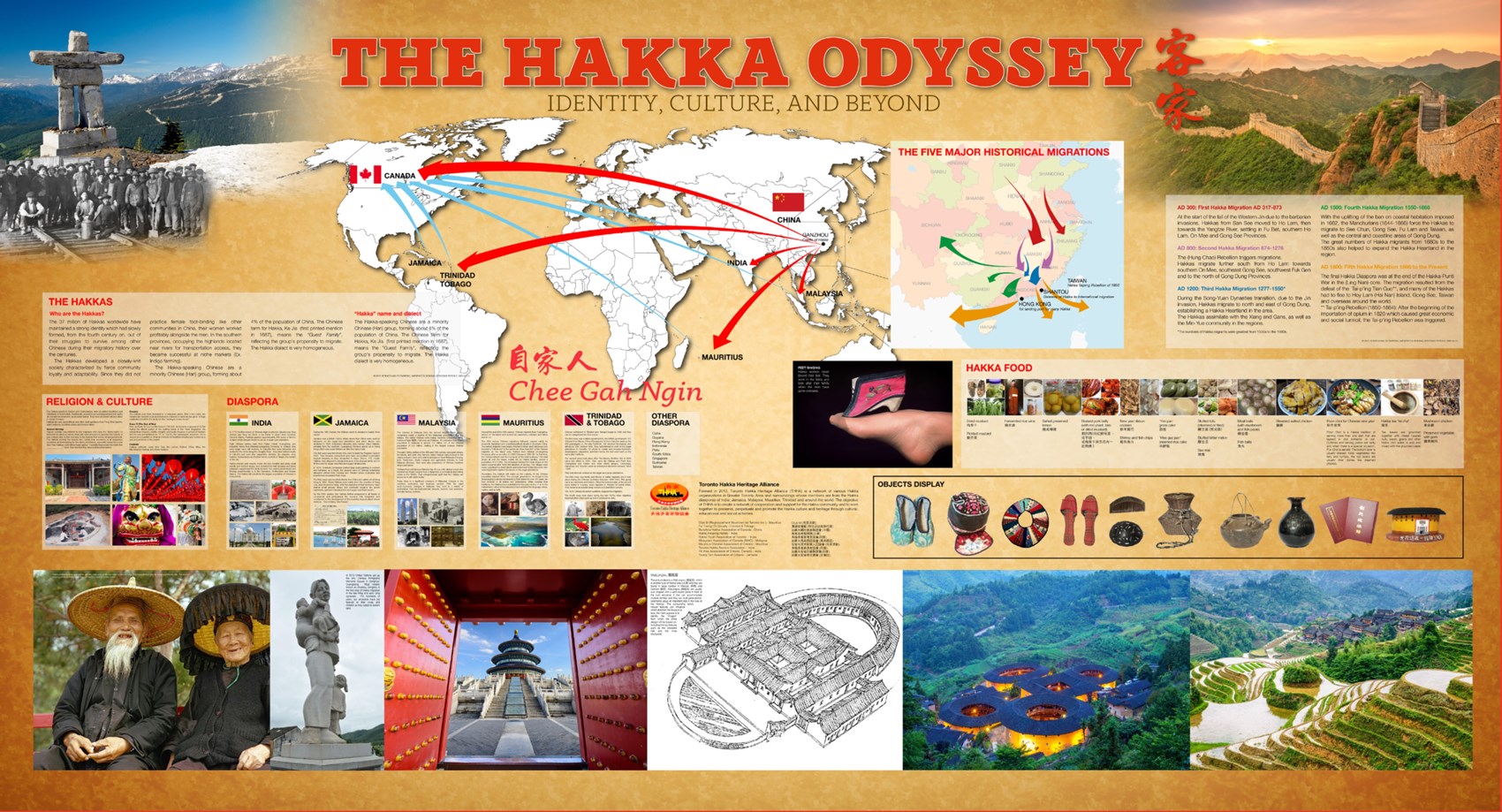
Who Are the Hakkas & The Hakka Spirit
The term Hakka (客家 - Ke Jia) literally translates to "Guest Families" or "Visiting Families". Originally migrating from the Central Plains of China, the Hakkas were regarded as guests by indigenous populations in the southern provinces where they eventually settled. Over centuries of movement and adaptation, what began as a historical designation transformed into a proud badge of identity.
Centuries of displacement forged the famous Hakka Spirit (客家精神)—a deep-seated cultural ethos defined by hard work, frugality, perseverance, self-reliance, and unwavering respect for education and ancestry. Facing rugged terrain and social adversity, Hakka pioneers carved out agricultural livelihoods in mountain highlands.
Uniquely, Hakka women never bound their feet, enabling them to labor equally alongside men in mountain farming, trade, and community defense. Today, the 80 million Hakkas worldwide maintain this resilient heritage across global diaspora communities.
Forming about 4% of the population of China, the Hakka-speaking Chinese remain a distinct ethnic subgroup bound by a highly preserved, ancient dialect.
自家人
Chee Gah Ngin
"Our Own People" — An enduring cultural philosophy embodying hospitality, mutual support, kinship, and unity across the global Hakka diaspora.
The Five Major Historical Migrations
AD 317 – PresentAt the start of the fall of the Western Jin due to barbarian invasions, Hakkas from Shanxi moved to Ho Lam, then towards the Yangtze River, settling in Fu Bei, southern Ho Lam, On Wei, and Gong See Provinces.
The Huang Chao Rebellion triggers migrations. Hakkas migrate further south from Ho Lam towards southern On Wei, southeast Gong See, southwest Fu Kim and to the north of Gong Dung Province.
During the Song-Yuan Dynasties transition, due to the Jin invasion, Hakkas migrate to north and east of Gong Dung, establishing a Hakka heartland in the area. The Hakkas assimilate with the Wang and Gao, as well as the Min Yuet community in the region.
With the uplifting of the ban on coastal habitation imposed in 1662, the Manchurians (1644–1868) force the Hakkas to migrate to See Chui, Gong See, Fu Lam, and Taiwan, as well as central and coastal areas of Gong Dung. Great numbers of Hakka immigrants from 1680s to 1780s expanded the Hakka Heartland.
The final Hakka Diaspora was at the end of the Hakka-Punti War in the 3 Ning Sze county. The migration resulted from the defeat of the "Tai Ping Tian Guo", and many Hakkas fled to Hay Lam, Poi San, Ngee On, Gong See, Sen-seew and overseas around the world. Taiping Rebellion (1850–1864) and importation of opium in 1820 caused economic and social turmoil, prompting further migrations.
Explore Exhibition Halls
Select an exhibition hall or diaspora portal below to explore dedicated galleries and detailed records.